All posts
Tag

d3

1 post tagged “d3”.

Standing waves from two travelling waves

Pluck a guitar string and the wave that races towards the bridge reflects and comes back. The string then carries two identical waves moving in opposite directions, and what you see is neither of them: a pattern that stays in place and only breathes up and down.

Adding the two waves #

Take two waves of the same amplitude AA, wavenumber kk and angular frequency ω\omega, one moving right and one moving left:

y1=Asin⁡(kx−ωt),y2=Asin⁡(kx+ωt). y_1 = A \sin(kx - \omega t), \qquad y_2 = A \sin(kx + \omega t).

Their sum, by the identity sin⁡a+sin⁡b=2sin⁡a+b2cos⁡a−b2\sin a + \sin b = 2 \sin\tfrac{a+b}{2} \cos\tfrac{a-b}{2}, is

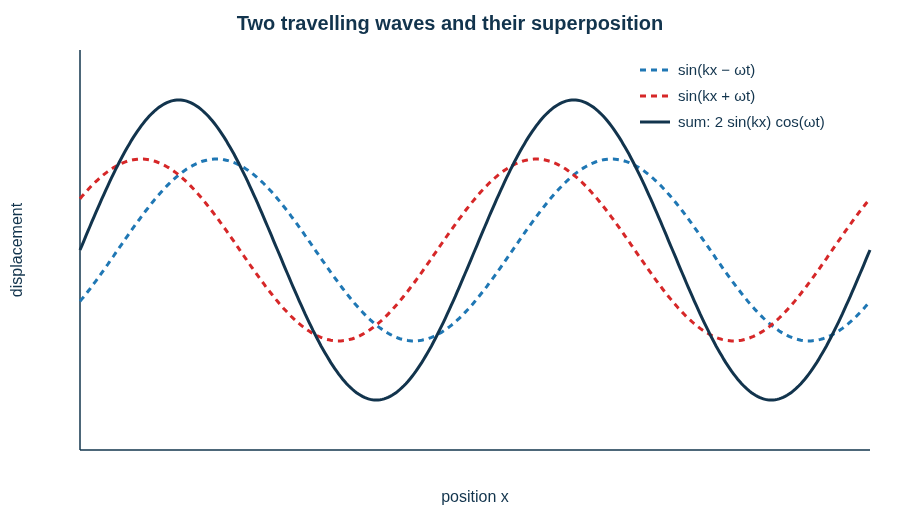
y=y1+y2=2Asin⁡(kx) cos⁡(ωt). y = y_1 + y_2 = 2A \sin(kx)\,\cos(\omega t).

The position and the time have separated. Every point of the string moves in step, with an amplitude 2Asin⁡(kx)2A\sin(kx) that depends only on where it is.

Two dashed travelling waves and their solid sum, a standing wave, at one instant
Two travelling waves (dashed) and their sum (solid). With JavaScript, this figure animates.

Nodes and antinodes #

Where sin⁡(kx)=0\sin(kx) = 0, at x=nπ/kx = n\pi/k or every half wavelength, the string never moves: these are the nodes, marked in the figure. Halfway between them the amplitude reaches 2A2A, the antinodes. A string of length LL fixed at both ends can only hold waves that put a node at each end, so its allowed wavelengths are

λn=2Ln,n=1,2,3,… \lambda_n = \frac{2L}{n}, \qquad n = 1, 2, 3, \ldots

which is why a string sounds a fundamental note and its harmonics, and nothing in between.